
On this page
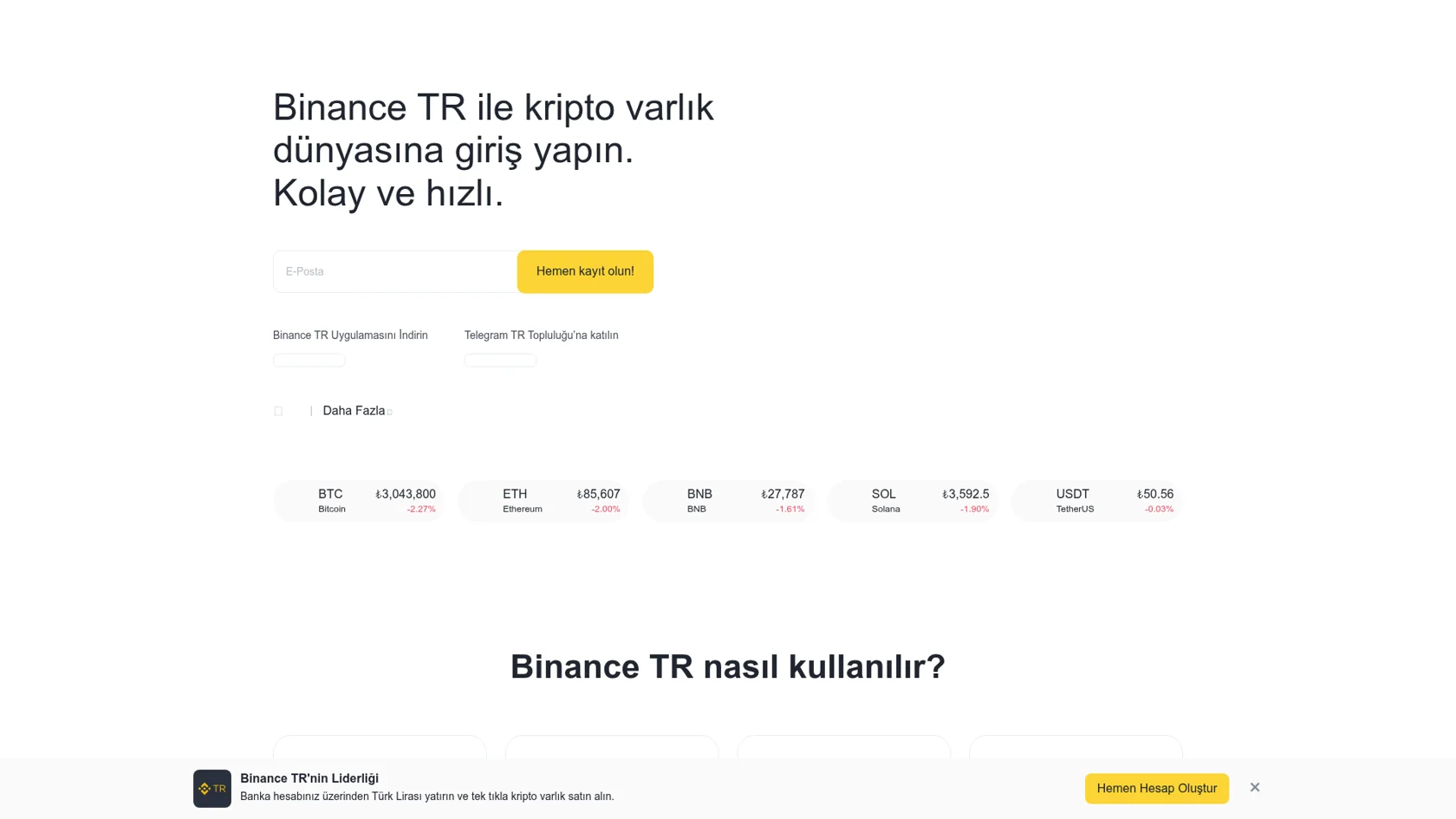
- Reported 24h volume · USD
- Unavailable
- Provider-tracked markets
- Unavailable
No matching provider venue · CoinPaprika. Venue aggregates are separate from regional eligibility and pair liquidity.
Select a region to focus the conditions. The article covers the United States, United Kingdom and EEA.
Binance TR begins with the account you intend to use
Binance TR is the Turkish service. A Binance.com account, the international fee table and a global market aggregate do not establish the same contract, banking route or withdrawal conditions.
Start with a written transaction: the money or asset you have now, the product that will hold it, the order you plan to place and the recipient at the end. Those four details reveal whether this service fits the task. A person funding once and withdrawing immediately has different priorities from someone maintaining an execution balance. The second person may care about repeated orders and records; the first may find that a withdrawal minimum or payment charge decides the outcome before the trading commission matters.
The first-TRY-deposit warning can change the timing of an immediate buy-and-withdraw plan. Read that warning before funding rather than discovering it after buying the asset.
| Decision | What to establish for Binance TR |
|---|---|
| Product | Turkish account and bank |
| Starting asset | Cash currency or exact token and chain |
| Execution | Quote or permitted spot order book |
| Destination | Your bank account, another exchange or your own wallet |
| Cost evidence | Current account quotes, completed fills and transfer receipt |
The practical starting point is the official product page, followed by the account terms and instructions linked from it. Public advertising describes an offer; your accepted agreement and transaction confirmation describe the operation available to your account. Preserve the distinction when comparing alternatives on PARA.
Residence determines which Binance TR service you can use
The official Turkish identity update describes renewed identity requirements for existing users, while TRY funding requires a matching account-owner bank relationship. US, UK or EEA residence alone does not establish eligibility for this local service.
| Scope to record | Why it belongs in the transaction record |
|---|---|
| Product: Binance TR | Another service under the same brand may use different terms |
| Public entry point: https://www.binance.tr/tr | Start from the official site rather than an unsolicited link |
| Account category | Personal and institutional onboarding are separate checks |
| Residence and state | A supported country need not support every state or asset |
| Check date: 24 November 2026 | Terms can change after this edition |
United States: identify the exact product and state before starting an application. A global trading page or a US-dollar pair does not establish US account access. If the documented terms exclude US persons or US residents, do not treat a different connection or an overseas bank account as changing that condition. Nationality, residence, incorporation and beneficial ownership can be separate questions.
United Kingdom: establish the relevant onboarding process and permitted product. A global campaign is not a UK invitation, and access to an existing account is different from eligibility for a new account or a particular service. Where a local financial-promotion process or waiting period applies, complete the actual account flow rather than inferring permission from a translated page.
EEA: use the country-specific entity, agreement and asset rules. EEA coverage includes Iceland, Liechtenstein and Norway as well as EU states. A global token list, fee programme or stablecoin pair does not automatically describe the local account. The country finder distinguishes sourced restrictions from unresolved checks; its result is a dated document finding, not an account approval.
Custody and security have operational consequences
Binance TR account balances remain custodial. Binance Transfer and an on-chain transfer to an independently controlled wallet are distinct operations with different recipient and eligibility checks.
Current operator incident and network notices should be checked for the actual account before funding. This edition does not infer a clean incident history from the absence of a notice in a public marketing page.
Treat access to the exchange account as one part of security. Email access, authentication devices, withdrawal controls and recovery procedures each protect a different action. Record the official recovery route before losing a device, and keep recovery information outside the device it restores. A familiar logo in a message is not evidence that the sender can legitimately request a transfer or an authentication code.
| Evidence or control | Useful question | Limit |
|---|---|---|
| Account authentication | Can an unauthorised person log in? | Login protection does not validate a destination |
| Withdrawal control | Can a new recipient be added immediately? | A permitted address can still be wrong |
| Reserve publication | Which assets and time does it cover? | It does not promise future access |
| Incident notice | What happened and what operations changed? | A preliminary statement is not a final investigation |
| Recovery process | What restores account access? | It may involve a withdrawal hold |
Before a substantial deposit, inspect current operator notices and the relevant network status. No personal deposit, support response or withdrawal test is claimed here. Security claims should be attached to the party making them, their date and their scope. A statement that a service reimbursed an earlier event does not establish the outcome of a future interruption.
Check the asset, pair and network as separate fields
A token symbol is not enough to specify a transfer. Identify the asset, chain, token contract where relevant and any destination tag or memo. Then establish that the sending product can withdraw it and the recipient can credit it. A supported trading pair and a supported withdrawal network are separate pieces of information, and either can change while the other remains visible.
For Binance TR, follow the account’s actual deposit and withdrawal instructions. An asset may appear in a public catalogue without being tradable in your jurisdiction, transferable on your preferred chain or eligible for the minimum size you intend to use. Wrapped assets and bridged representations add another identity question: the receiving platform must support the representation actually sent.
If you intend to buy specifically for self-custody, settle the receiving network before placing the order. Calculate the quantity left after trading fees, withdrawal charges and minimums. A small successful test can check a route when practical, although another transfer creates another cost and a later transfer can still face a new restriction. Preserve the address and network evidence with the final receipt.
Market activity is context for a particular order
PARA displays provider-reported 24-hour venue volume and tracked market counts where CoinPaprika supplies a matching venue. These figures describe the provider’s aggregate coverage. They are not the depth of your chosen pair, a complete asset inventory or a promise that a budget will fill at the last displayed price. Missing data is shown as unavailable rather than replaced with a score.
| Market observation | What it describes | What you still need |
|---|---|---|
| Venue volume | Reported activity across covered markets | The exact pair and permitted product |
| Tracked markets | Provider-covered trading markets | Asset and network availability |
| Best bid and ask | Prices at the top of one book | Quantity available at those prices |
| Recent price | A particular trade or aggregate | An executable quote for your size |
| Order-book depth | Visible levels at a moment | Fees, latency and any hidden interest |
For a larger order, inspect several price levels and decide how much execution deviation you will accept. A narrow spread at a tiny quantity does not establish a low total execution cost. A resting order may not fill; an immediately matching order may cross levels. The right comparison uses the same asset, currency, budget and time window.
Choose the order instruction before comparing a trading rate
An order book separates your price instruction from the market’s willingness to execute it. A marketable order seeks an immediate match. A limit instruction sets a price boundary, but it can still execute immediately against existing interest and incur the taker rate. A partly filled order can leave a remaining balance or open instruction that needs separate attention.
With Binance TR, establish which order types belong to the permitted spot product before using automation or leverage. A stop condition concerns when an instruction is submitted; it does not guarantee the final execution price. A post-only condition, where supported, concerns resting on the book and may reject an order that would immediately match. Product documentation takes precedence over assumptions based on a similar interface elsewhere.
Keep a record of the instruction, completed fills, fee asset and unfilled remainder. This makes a rejected order distinguishable from an executed order and prevents a retry from accidentally duplicating exposure. A spot purchase without borrowing has a different cost and risk model from a margin position or derivative; do not move an attractive rate across those boundaries.
The fee schedule prices only part of the route
Use the current Binance TR tariff and the account VIP level. Older help material and the current homepage can differ on a cash-withdrawal charge, so the transaction confirmation and current local fee page matter.
The useful cost is the difference between the complete starting outlay and the value that reaches the chosen destination, using a consistent measurement basis. It can include a bank debit, card charge, conversion, trading commission, execution deviation and withdrawal charge. Two routes can have the same trading commission and produce different final amounts because they start or end differently.
| Cost stage | Evidence to retain | Question for the comparison |
|---|---|---|
| Funding | Bank/provider receipt and credited balance | Is the fee deducted or charged separately? |
| Conversion | Cash paid and asset received | Is a spread embedded in the quote? |
| Spot execution | Pair, fills and fee asset | Which maker/taker tier actually applied? |
| Exit | Withdrawal quote and received amount | What currency and network reach the recipient? |
| External charges | Issuer, bank or FX statement | Are these outside the exchange’s quoted total? |
Use the cost calculator with current inputs. Its numbers model a route and do not connect to an exchange account. A percentage saving should be considered at the expected transaction size: a fixed withdrawal charge can dominate a small purchase, while repeated execution costs can dominate a frequently traded balance.
For an arithmetic illustration only, take a 2,625.00 USD starting budget, a 0.50% funding charge, a 0.10% trading charge, a 0.20% execution-deviation assumption and a 3 USD withdrawal. These are deliberately hypothetical inputs, not a Binance TR tariff or a prediction of market movement. Each percentage applies to the remaining balance.
| Illustrative stage | Amount, USD |
|---|---|
| Starting budget | 2,625.00 |
| Funding charge | 13.1250 |
| Trade commission | 2.6119 |
| Execution deviation | 5.2185 |
| Withdrawal | 3.0000 |
| Destination amount | 2,601.0446 |
This calculation ends at the chosen recipient. It excludes taxes and any unstated bank, issuer or foreign-exchange charge. Replace all assumptions with the actual quotes before using the result to compare routes. A cash round trip requires a second execution stage and may use a different exit charge.
Funding is complete only when the correct balance is credited
TRY transfers must originate from and return to eligible bank accounts in the verified customer’s own name. The official deposit instructions distinguish local transfer methods and warn of a crypto-withdrawal restriction after the first TRY deposit.
A bank’s completed payment, a payment provider’s accepted order and an exchange’s available balance are different stages. Check the required beneficiary, reference, supported currency, account-holder name and minimum before sending. A transfer in a different currency can introduce a conversion or return process; a missing reference can require a manual allocation rather than automatically crediting the trading account.
| Before payment | After payment |
|---|---|
| Confirm the account is eligible for this route | Retain the sending institution’s reference |
| Read current beneficiary instructions | Match the credited amount and currency |
| Establish any hold on withdrawal | Check when the balance becomes transferable |
| Identify the party handling a problem | Keep provider and exchange case references separate |
The funding finder lists documented routes with their scope. A missing route is an unresolved coverage question, not a conclusion that Binance TR offers no such service. For a third-party purchase, read that provider’s instructions and settlement terms as well as the exchange account terms.
Identity checks and recovery affect the transaction timetable
Verification can involve residence, identity, beneficial ownership, source of funds and the relationship to the sending bank or wallet. Prepare consistent records before an application or substantial transfer. A completed identity check does not establish that every product, asset or funding provider will accept the account, and an account limit can depend on more than one verification step.
For Binance TR, identify the actual contracting product and customer category before uploading documents through the official account flow. A personal account should not be assumed to support a company’s operating funds. For a business account, authorised-user permissions and beneficial-owner information need their own records. Do not share authentication secrets with someone offering to accelerate the process through a chat message.
After an email, password or security-device change, inspect the applicable withdrawal conditions before relying on immediate access. Recovery restores account access through the operator’s process; it does not reverse an already completed external transfer. Keep the distinction clear when building a time-sensitive payment plan or choosing where to hold an execution balance.
Mobile use should preserve the same product distinctions
Begin with the official website and follow its current app links. Confirm the publisher, product name and regional availability before installing. An application-store result with a similar name, a sponsored search result or an unsolicited download link is not enough to identify the intended product. Device requirements and available functions should be checked for the version actually used.
On a small screen, inspect the balance selected for the operation. A simple purchase, spot order, internal transfer and external withdrawal can all change a portfolio display while creating different fees and evidence. Before confirming, read the asset, currency, quantity, account and destination. A compact confirmation should not be treated as permission to skip those fields.
The first-TRY-deposit warning can change the timing of an immediate buy-and-withdraw plan. Read that warning before funding rather than discovering it after buying the asset.
Plan for device loss as an operational problem. Know how to revoke sessions and restore authentication from an independent device, and retain official support access outside the app. The mobile section follows installation, execution, transfers and recovery without claiming an installation or timed usability test that was not performed.
An external wallet changes who must authorise and recover
Binance TR account balances remain custodial. Binance Transfer and an on-chain transfer to an independently controlled wallet are distinct operations with different recipient and eligibility checks.
Before moving from Binance TR to self-custody, identify the receiving wallet’s exact signing design. A recovery phrase, hardware-device backup, encrypted cloud recovery and a multi-party signing arrangement are different systems. Preserve the material the actual wallet requires; do not impose one recovery procedure on every product that uses the word wallet.
| Operation | Who must act | Evidence worth preserving |
|---|---|---|
| Exchange withdrawal | Account holder requests, operator processes | Request reference and transaction hash |
| Wallet receipt | Network and receiving wallet recognise transfer | Correct chain and credited asset |
| On-chain send | Wallet signer authorises the transaction | Destination, network fee and signed result |
| Contract interaction | Wallet signer approves a specific permission | Contract, spending allowance and action |
Once an asset is in a self-controlled wallet, subsequent transactions may require the chain’s fee asset. A token balance alone may not pay the next network fee. Establish the return route to an exchange or bank before assuming that an asset can be cheaply moved, swapped or redeemed later.
Yield and borrowing need their own repayment conditions
An exchange navigation can place Earn, staking, lending or margin alongside ordinary balances. The economic arrangement changes even when the account login stays the same. Establish who owes repayment, what determines the reward, whether the principal can change and when the balance can be redeemed. A percentage displayed for an annualised period is not the cash amount received over a shorter holding period.
For Binance TR, use the terms for the named programme and the local account. This article does not infer programme availability from a global button. A collateralised loan creates a repayment obligation and may introduce liquidation or collateral-conversion conditions. A staking arrangement can involve network rules as well as the platform’s redemption process. A lending arrangement adds a different counterparty question.
Keep these balances outside a simple spot-cost calculation unless the planned transaction actually requires them. A reward that needs a locked asset, continuing balance or trading commitment must be valued with that requirement attached. Read the redemption and termination provisions before moving a balance needed for an upcoming withdrawal into a yield product.
Automation starts with the smallest permission set
Where Binance TR provides an API, identify whether the intended integration needs public market data, account records or trading authority. Public price retrieval does not require access to a personal balance. A portfolio reporting tool should not receive permission to withdraw assets merely because a setup screen offers that permission alongside read access.
| Integration task | Permission to examine | Operational record |
|---|---|---|
| Display market data | Public-data terms and rate limits | Source and timestamp |
| Reconcile balances | Account read access | Ledger period and account scope |
| Submit orders | Trading authority | Client ID, order ID and fills |
| Move assets | Transfer or withdrawal authority | Destination controls and authorisation |
Store credentials outside public frontend code and set any supported restrictions appropriate to the task. A timeout does not establish that an order failed; check its identifier before retrying. Test calculations separately from live order submission. PARA’s public market widgets never request exchange-account credentials and do not place orders on behalf of a reader.
A reward matters only if the usable benefit exceeds the extra cost
Treat a welcome offer, trading credit, fee rebate, token allocation and recurring account benefit as different things. Record the eligible customer, jurisdiction, qualifying activity, deadline, expiry and usable form of the benefit. A headline maximum is not an allocation to every applicant. An account credit may offset a particular cost without becoming withdrawable cash.
For Binance TR, any fee-token requirement belongs in the transaction’s economics. Acquiring an asset to pay fees can add conversion and withdrawal costs, and its value can change during the holding period. A volume threshold may require more trading than the original task needs. Compare the route without the reward first, then add only the incremental benefit and genuinely extra qualifying costs.
The reward calculation accepts your own usable value. No promotional code or universal allocation is promised in this article. UK readers should establish local eligibility before considering a global campaign. A programme associated with a different regional product must not be imported into the account simply because the brand is shared.
The ecosystem does not make every transfer internal
Binance TR is the Turkish service. A Binance.com account, the international fee table and a global market aggregate do not establish the same contract, banking route or withdrawal conditions.
Follow the counterparty through each step. Moving from an exchange to a branded wallet, a card provider, a payment partner or a third-party protocol can change who holds the asset, who signs a transaction and who handles a dispute. A convenient link and a common design do not resolve those questions. Read the destination instructions before starting the move.
An internal transfer changes account records without necessarily producing a blockchain transaction. An external transfer produces network evidence but can still require the recipient to credit the correct customer. A bank return, protocol redemption and exchange withdrawal each have different completion criteria. Keep the route explicit enough that you can identify which stage has stopped if the final balance is missing.
For a simple planned purchase, additional ecosystem features are useful only when they serve that route. Do not add a bridge, another token or an extra custodial account merely to use a promoted feature. Every additional stage adds another fee quote, permission decision or recovery responsibility that should earn its place.
Support is more useful with a transaction record
Contact the party responsible for the stage that has not completed. A sender’s bank can investigate its payment reference; a payment provider can explain its purchase order; Binance TR can inspect an account-credit or withdrawal request. A receiving exchange may require its own deposit details even when a blockchain explorer already shows a completed transfer.
| Problem | First evidence to collect |
|---|---|
| Cash not credited | Currency, beneficiary, bank reference and date |
| Crypto not credited | Asset, chain, transaction hash and required memo |
| Order uncertainty | Account, client order ID and execution history |
| Withdrawal pending | Request reference, status and stated hold |
| Recipient missing funds | Network confirmation and recipient credit rules |
Use the official support route reached from the product website or authenticated account. Do not send passwords, recovery phrases or authentication codes as evidence. A person who contacts you first with an unsolicited recovery offer should not receive signing authority. This article does not invent support response times or imply that an issue has been resolved through a test conversation.
Records should reconcile the whole route
Keep the original account statements and transaction exports for the period that includes funding, execution and exit. A portfolio screenshot can show a balance without explaining how it was obtained. Reconciliation requires the cash or token movements, completed fills, fees, internal transfers and final receipts to fit together without counting the same movement twice.
For Binance TR, retain product and account identifiers alongside exports. If several interfaces share a login, a consumer statement, institutional ledger and wallet history may cover different operations. Label the currency used for amounts and distinguish the token in which a fee was charged from a later valuation in cash. An export should preserve the source precision rather than replace original quantities with rounded display numbers.
These records help explain the transaction and prepare a consistent history for professional advice where needed. Tax treatment depends on jurisdiction and circumstances; a generic profit figure or cash withdrawal amount is not a complete tax calculation. Retain evidence before closing an account or relying on a provider’s future export availability.
Compare alternatives against the same destination
Compare Binance TR with another service using the same permitted product, account category, currency, asset and final recipient. A cheap execution rate on an inaccessible product is not an alternative. A simple purchase quote and a spot commission also start from different evidence: the quote needs the final asset amount, while an order-book route needs the applicable rate, fills and additional transfer costs.
Use the comparison page to keep product conditions together, then model the actual amounts in the calculator. The market page supplies aggregate price context, not an executable quote. If the asset is already in a self-controlled wallet, compare the complete cost of depositing, trading and withdrawing against a permitted same-chain exchange route with its own signing and network requirements.
The final recipient is often what makes the comparison useful. A route that ends with cash in your own bank account differs from one that leaves a token on another platform. Neither should be called cheaper until both have been priced to the same stopping point, including costs paid outside the exchange.
Questions that affect the next transaction
Does a public Binance TR price establish that I can open an account?
No. Establish the actual product, residence, customer category and any state or asset restrictions through the applicable terms. A public quote does not perform those checks.
Can I use the market figure on PARA as my order price?
The figure is an aggregated provider snapshot. An executable quote depends on the permitted account, pair, order size, order instruction and current book. Trading and transfer costs remain separate.
Why might a completed deposit still be unavailable for withdrawal?
Crediting, settlement, identity checks and a product's withdrawal hold can be separate stages. Read the specific funding warning and preserve the payment or transaction reference before contacting the responsible party.
What should I confirm before moving assets into my own wallet?
Confirm the exact asset and chain, destination requirements, withdrawal charge, net quantity and the wallet's signing and recovery design. Preserve enough native network-fee asset for later operations where required.
Sources and the decision before funding
Official product and support material was consulted for this edition on 24 November 2026. The facts describe the named product and the scope attached to each statement. A missing account-specific quote remains a value to establish before transacting; it is never replaced with a fictional tariff. Provider market snapshots have their own timestamps and can update independently of the article.
Before sending funds to Binance TR, open the applicable account terms and the actual funding and withdrawal confirmation screens. Record the route, its costs and any holding period. If the final recipient cannot receive the asset or currency through that route, resolve that question before the first deposit rather than after the order has filled.
Source date · 2026-11-24 · About sources and calculator examples